
How to Understand Your Electricity Bill

The Definitive Guide: How to Understand Your Electricity Bill (and Stop Overpaying)
Electricity bills seem designed so that nobody can understand them. Dozens of technical terms, complex charts and hidden charges mean that most customers pay their bills every month without knowing exactly why.
In this guide, we explain, in a simple and straightforward way, what you should look out for when you open your bill and where the most common cost overruns are hidden.
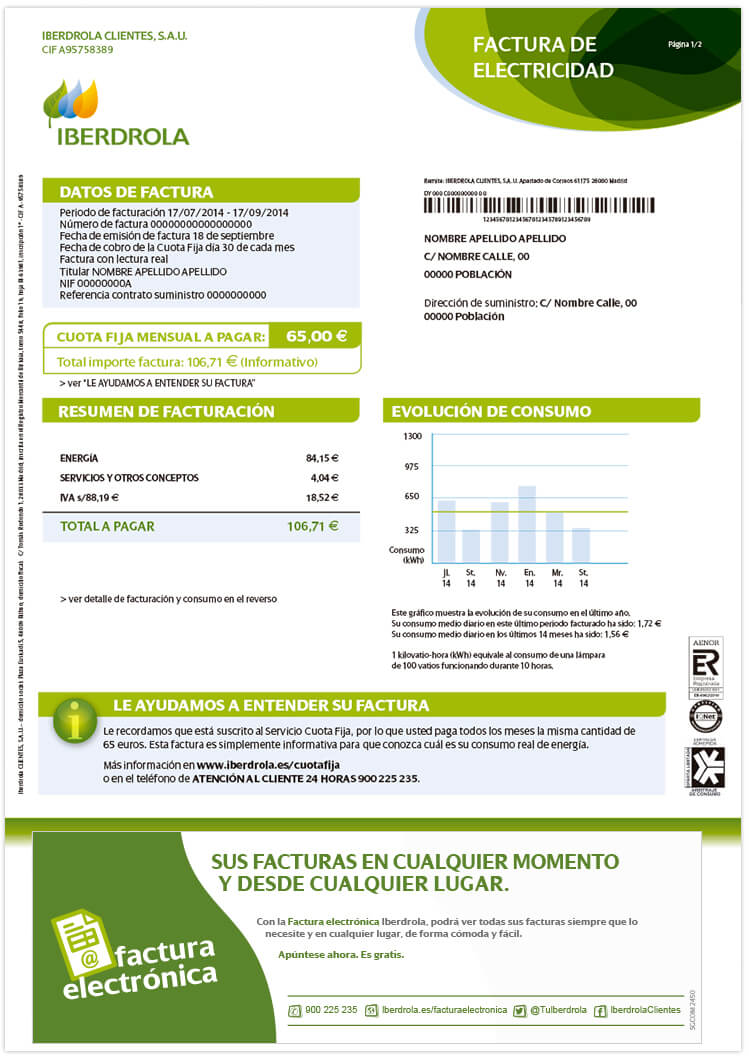
1. The 5 Key Sections of Your Invoice Explained
A. Contract Details
This is the header of your invoice. Although it may seem like mere paperwork, it contains two vital pieces of information:
- CUPS (Unified Point of Supply Code): It is the “ID” of your electrical installation. It consists of 22 characters and begins with
EN. You’ll need this if you switch providers or want to compare savings plans. - Market type: Please indicate whether you are in the Regulated Market (PVPC) (the price changes every hour depending on the market) or at the Mercado Libre (You pay a price agreed in advance with the supplier).
B. Power Charge (What you pay for “having electricity”)
It’s a fixed cost that you pay every month, even if you don’t use a single kilowatt. It is measured in kilowatts (kW).
The danger: Many homes and businesses have contracted for more power than they actually need. Simply reducing 1 kW An oversized power rating can save you between €40 and €60 a year.
C. Energy Charge (What you actually use)
This is the variable part of the bill. It represents the amount of electricity you have used during the billing period. It is measured in kilowatt-hours (kWh).
Time slots? If your tariff distinguishes between Point, Plain and Valley, take a look at what time of day you use the most electricity. If the price difference between the different bands is very high, adjusting your habits (or switching to a fixed price per kWh) can make a big difference.
D. Additional Services and Maintenance
This is the area where the most money is quietly lost. Check whether your breakdown includes items such as:
- 24-hour home assistance / emergency service.
- Maintenance of the electrical installation.
- Payment protection insurance.
 Please note: These services are often activated through limited-time offers and end up increasing your bill by between €3 and €15 a month, even if you don’t use them.
E. Taxes and Tolls
- Electricity Tax: A regulated tax on the sum of power and energy.
- Rental of measuring equipment: The amount you pay the supplier for the use of the digital meter (usually around €0.80 – €1.50 per month).
- VAT: Applied to the total amount of the invoice in accordance with current legislation.
2. Checklist: Are you being overcharged?
Run your invoice through this quick check:
If you’ve been with the same provider for more than 12 months without reviewing your contract, it’s very likely that you’re on a higher-priced tariff.
If the answer is “never”, you may be able to reduce your contracted power rating.
If this message appears, you need to install a capacitor bank as a matter of urgency to avoid losing money.
3. Would you like us to analyse it for you within 24 hours?
You don’t need to become an energy expert. In CYC Energy We review your electricity or gas bill 100% – free and with no obligation.
- Upload a photo or PDF of your latest invoice.
- We analyse your power rating, rate per kWh and the services you have signed up for.
- Here’s a comparison of how much you’d pay with the best option currently available on the market.
Attach your invoice and we’ll send you the savings report: